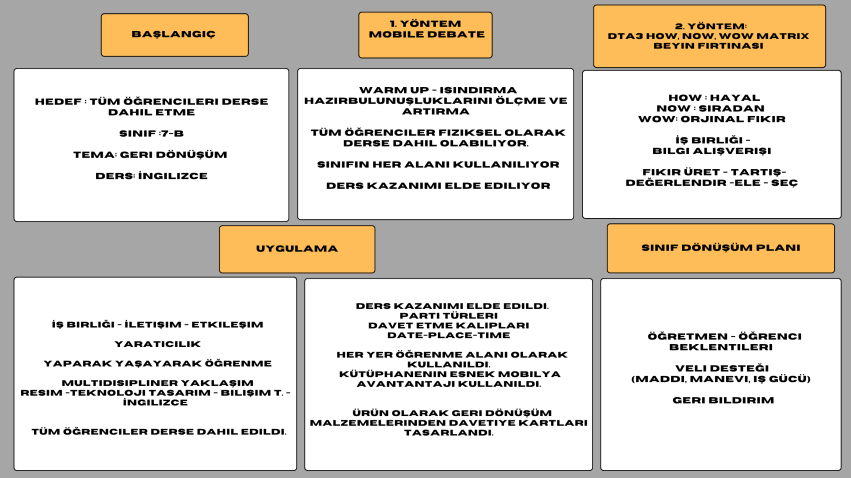
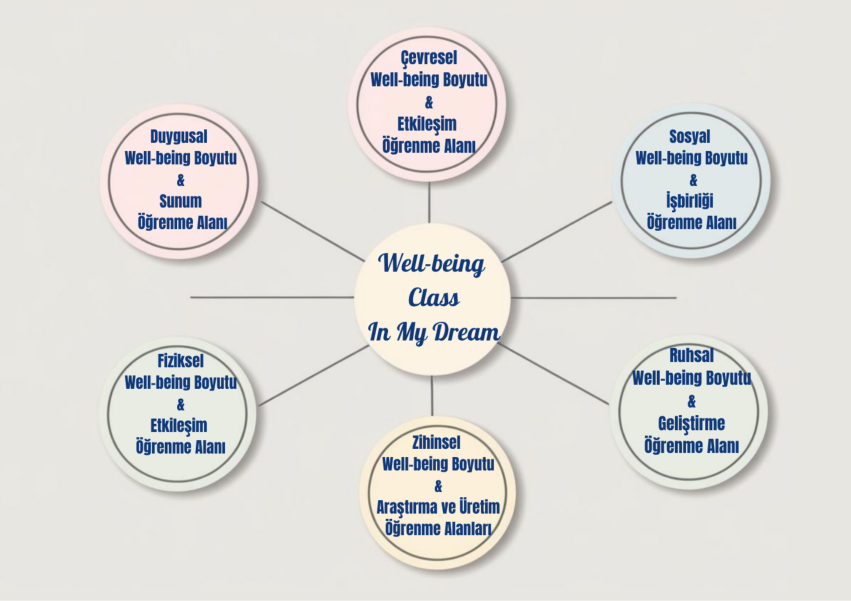
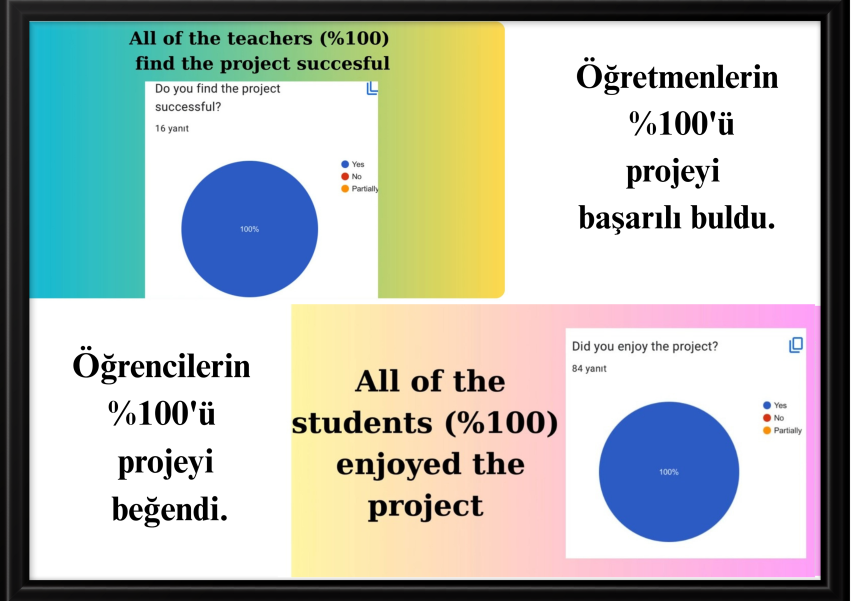
Active learning is a learning approach in which the student is not a passive listener but takes an active role in every stage of the learning process such as decision-making, planning, participation, production and discovers information by doing & experiencing. In order to encourage active learning, it is important to create innovative, flexible, sustainable learning spaces, design future classroom labs and support well-being of students. The biggest obstacle to active learning is traditional classrooms. In this article, two sample studies will be introduced on designing innovative, flexible learning spaces where students can work in collaboration, communication unlike traditional classrooms. The first study is a learning scenario prepared within the scope of “Students as Designers of Learning Spaces” Mooc course in personal development module on eTwinning platform. Producing learning scenarios guides teachers in all processes from lesson planning to evaluation and makes active learning effective. The second study is “Well-being Class In My Dream” eTwinning project which included fifteen partners from six countries. In the project, instead of studying two different subjects, namely future classroom labs and well-being separately, a new strategy was produced by identifying and matching the similar aspects of these two subjects that develop the same skills of students, meet the same needs, expectations. These sample studies, which address how the obstacles to active learning can be overcome with a solution-oriented perspective, also aim to develop students’ 21st century skills. Results of these studies will inspire new studies to be carried out in this field.
Cite this Article As :
Çapkın, Ş. (2025). Aktif öğrenme ve geleceğin sınıf laboratuvarları. Edutech Research, 3(2), 70-87.
Edutech Research
2025, Vol. 3 (2)
E-ISSN: 3023-6665
Received : ,
Accepted : ,
Published Online :
References
Allardt, E. (1973). A Welfare Model for Selecting Indicators of National Development. Policy Sciences, 4, s. 63–74. doi:10.1007/BF01404933
Bloom, B. S. (1956). Taxonomy of Educational Objectives: The Classification of Educational Goals, Handbook 1: Cognitive Domain. New York: David McKay.
Bonwell, C., & Eison, J. (1991). Active Learning: Creating Excitement in the Classroom. ASHE-ERIC Higher Education Report.
Dewey, J. (1916). Democracy and Education: An Introduction to the Philosophy of Education. New York: Macmillan Publishing.
Dewey, J. (1938). Experience & Education. New York: NY: Kappa Delta Pi. ISBN 978-0-684-83828-1.
European Commission. (2018). Proposal for a Council Recommedation on Key Competences for Lifelong Learning. https://eur-lex.europa.eu/legal-content/EN/TXT/PDF/?uri=CELEX:52018SC0014&from=EN adresinden alındı
European Schoolnet, the Future Classroom Lab (FCL). (2012). https://fcl.eun.org/ adresinden alındı
Johnson, D., Johnson, R., & Smith, K. (1991). Active learning: cooperation in the college classroom. Edina, MN: Interaction Book Company.
Konu, A., & Rimpelä, M. (2002). Well-being in schools: A conceptual model. Health Promotion International, 17(1), s. 79–87. doi:https://doi.org/10.1093/heapro/17.1.79
Norman, D. A. (1980). Cognitive engineering and education. In D.T. Tuma & F. Reif (Eds.), Problem solving and education:Issues in teaching and research (97-107). Hillsdale, NJ: Lawrence Erlbaum Associates.
Oblinger, D. (2006). Learning Spaces. Educause ISBN 0-9672853-7-2. www.educause/learningspaces adresinden alındı
OECD. (2017). The OECD Handbook for Innovative Learning Environments, Educational Research and Innovation. Paris: OECD Publishing. doi:https://doi.org/10.1787/9789264277274-en.
Piaget, J. (1952). The origins of intelligence in children. International Universities Press.
Slavin, R. (1990). Co-operative learning: Theory, research and practice. Prentice Hall, Englewood Cliffs.
UNESCO. (2013). Transversal Competencies in Education Policy and Practice. https://unesdoc.unesco.org/ark:/48223/pf0000231907 adresinden alındı
Vygotsky, L. S. (1978). Mind in society: The development of higher psychological processes. Harvard University Press.
Weinstein, C., & Mayer, R. (1986). The Teaching of Learning Strategies. New York: In: Wittrock, M, Ed., Handbook of Research on Teaching, Macmillan.
Wood, D., Bruner, J., & Ross, G. (1976). The role of tutoring in problem solving. Journal of Child Psychiatry and Psychology, 17(2), s. 89-100.



 Keywords